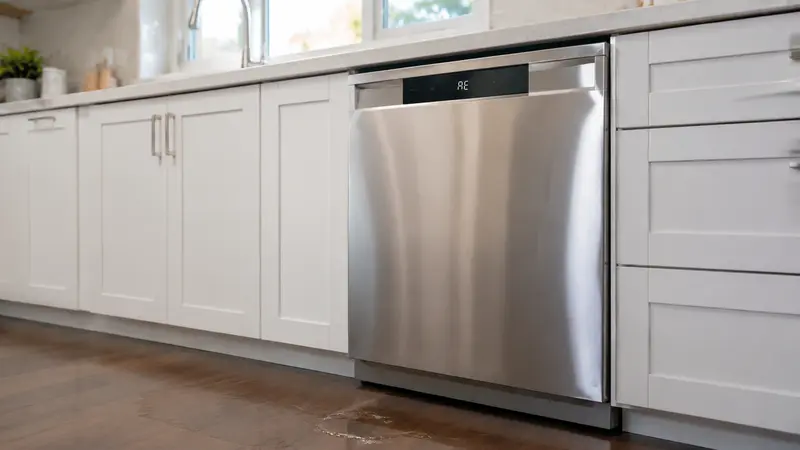
An LG dishwasher AE error usually means the appliance has detected water where it should not be, often in the base area, and has activated leak protection. An LG dishwasher showing AE may have a visible leak, excess suds, an installation/leveling issue, or moisture from an internal component. Turn the dishwasher off if water is leaking and do not keep resetting it until the source is understood.
Safety first: If water is spreading, stop the cycle, switch the dishwasher off, and close the water supply only if the valve is safely accessible. Keep clear of wet electrical areas. Never bypass leak sensors or other safety devices.
What Does AE Mean on an LG Dishwasher?
On supported LG dishwashers, the AE error code is associated with leak detection. Water reaching the base or leak-detection area can trigger protective draining and may prevent a new cycle from starting. AE is not the same as an LG dishwasher OE error, which is a drainage code.
Most Common Causes of the AE Error
- A visible leak at the door, tub, water-supply connection, drain connection, or a component inside the machine.
- Too much detergent or the wrong product causing excess foam.
- An improperly leveled dishwasher or an installation issue that lets water move where it should not.
- Moisture remaining in the base after an earlier overflow or leak.
The exact cause varies by model. Use the full model number and manual before following any model-specific procedure.
LG Dishwasher AE Error but No Visible Leak
Look at the floor in front of and beside the dishwasher, then check under the sink for accessible drips. Also look for excess foam, a door that is not closing cleanly, or moisture around accessible hose connections. If water is actively spreading or recurring, stop using the appliance.
A dry floor does not rule out moisture in the base or a small internal leak. Do not pull out the dishwasher, remove panels, or keep running cycles just to see whether the code returns. A repeated AE code still needs attention even when no water is visible externally.
Check the Door, Tub and Hoses
With the dishwasher off and cool, wipe food residue from the visible door gasket and tub lip. Make sure a pan handle, utensil, or tall item is not keeping the door from closing normally. Under the sink, inspect only accessible supply and drain-hose connections for drips, kinks, or damage. Do not pull the unit out or remove panels to reach hidden fittings.
Drainage and Over-Sudsing Checks
Hand dish soap or too much automatic-dishwasher detergent can create foam that pushes water into areas that trigger an LG dishwasher leak error. Use only detergent intended for automatic dishwashers. If standing water is also present, use our LG dishwasher not draining guide; drainage and leak detection are different faults, but both should be addressed before another normal cycle.
How to Reset an LG Dishwasher After an AE Error
- Turn the dishwasher off and disconnect power if this can be done safely.
- Correct only visible issues such as a blocked door seal, excess foam, or an accessible drip.
- Follow the reset or power-cycle instruction in the exact model’s manual.
- Restart only after the area is dry and no active leak is present.
A reset may clear a temporary state, but it does not repair a leak, failed seal, hose, pump, or sensor. Do not use an online reset sequence unless it matches the complete model number.
LG Dishwasher AE Error Keeps Coming Back
An AE code that appears once after a spill or foam event may clear only after the appliance is safely dried and the cause is corrected. If it returns after a reset, appears during a wash, runs the drain pump continuously, or comes with visible water, unusual noise, electrical odor, or a tripped breaker, treat it as an unresolved moisture or leak condition.
Do not repeatedly reset the dishwasher to hide a recurring fault. Continuous draining, water under the machine, or an error that returns immediately warrants professional diagnosis.
When to Call a Technician
Arrange service for recurring AE, a continuously running drain pump, water under the machine, a damaged door or tub, a tripped breaker, or any situation requiring internal access. Stop immediately for a burning smell, sparking, or water near electrical connections.
Frequently Asked Questions
Why is my LG dishwasher showing an AE error?
AE generally means the dishwasher has detected moisture where it should not be or a condition that triggered leak protection. Check for visible water, foam, door-seal issues, and accessible hose drips, then use the model manual for details.
Can an LG dishwasher show AE without a visible leak?
Yes. The floor may be dry while moisture remains in the base or a small internal leak is present. Do not assume the code is harmless because no water is visible outside the appliance.
How do I clear an AE error on an LG dishwasher?
Correct any visible cause first, then follow the safe power-cycle or reset instruction in your exact model’s manual. A reset can clear a temporary state but does not repair a leak or persistent detection condition.
Why does the AE error keep coming back?
A recurring code suggests the underlying moisture, leak, foam, or detection condition has not been resolved. Stop repeated resets and arrange service if it returns after basic checks.
What does AE error on an LG dishwasher mean?
It generally indicates leak detection: the dishwasher has detected water where it should not be or a condition that can trigger its leak-protection system.
Can too much detergent cause an LG dishwasher AE error?
Yes. Excess suds can contribute to water or foam reaching the leak-detection area. Use only automatic-dishwasher detergent in the correct amount.
Can I keep using an LG dishwasher showing AE if the floor is dry?
No. Water can be contained in the base, so a recurring code should be diagnosed rather than ignored.
Is AE the same as OE?
No. AE relates to leak detection; OE is a drainage code. See the LG Dishwasher OE Error guide for that separate issue.
Related Troubleshooting
For an LG dishwasher that will not drain, see LG Dishwasher Not Draining. For general water left in the tub while the dishwasher is not running, see Water in the Bottom of a Dishwasher When Not in Use. For other model-specific codes, see LG Dishwasher LE Error and LG Dishwasher IE Error.