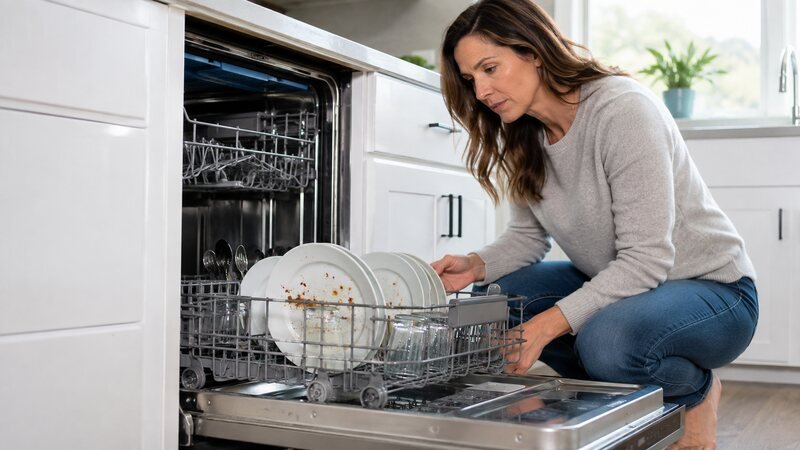
A dishwasher that runs but leaves food, film, or detergent behind often has a loading, filter, spray-arm, water-temperature, detergent, or water-supply issue. These checks focus on user-serviceable items and help distinguish cleaning performance from the separate problem of standing water.
Safety first: Turn off power at the breaker or unplug the dishwasher before removing a filter or inspecting below the racks. Let hot components and water cool. Wear gloves around broken glass, and never reach into a pump area the owner’s manual does not identify as user-accessible.
First, identify what “not cleaning” looks like
- Food remains: loading, blocked spray arms, clogged filter, or low water circulation.
- White film: hard-water minerals, detergent dosing, or rinse-aid settings.
- Grit redeposited on dishes: dirty filter, blocked spray jets, or drainage trouble.
- Detergent remains in the dispenser: blocked dispenser door, damp detergent, loading, or water-temperature/circulation issues.
- Top or bottom rack only: a blocked or disconnected spray arm or loading pattern may be involved.
Common reasons a dishwasher does not clean dishes
1. Dishes block the spray arms or detergent dispenser
Load items so neither spray arm contacts a pan, utensil, or tall plate. Make sure nothing protrudes through the rack and the detergent door can open fully. Face dirty surfaces toward the spray and avoid nesting bowls and spoons. Follow the rack diagram in the owner’s manual.
2. The filter is dirty or installed incorrectly
Many modern dishwashers have a removable filter at the bottom. Disconnect power, remove the lower rack, and follow the manual to unlock it. Rinse away debris with warm water and a soft brush; avoid wire brushes that can damage the mesh. Reinstall and lock it correctly. Do not run the dishwasher without the filter.
3. Spray-arm holes are clogged
With power off, rotate the arms by hand and check for interference. If the model allows removal, clean them according to the manual. Use a non-damaging tool only if the manufacturer recommends it, and make sure the arm is securely reattached. Cracks or split seams require the correct replacement part.
4. The incoming water is not hot enough
Dishwashers rely on appropriate incoming water temperature and internal heating. Run the kitchen faucet until hot before starting if the manufacturer recommends it. Check the model’s required inlet temperature; do not raise the home water heater to an unsafe setting. A dishwasher that never heats may need service.
5. Detergent or rinse aid is unsuitable
Use fresh automatic-dishwasher detergent—not hand dish soap—and store it dry. Dose according to the detergent label, dishwasher manual, soil level, and water hardness. Too much detergent can leave residue; too little may not handle heavy soil. Use rinse aid if recommended, especially with hard water.
6. Heavy pre-rinsing confuses a sensor cycle
Scrape off bones, seeds, and large food pieces, but some sensor models are designed to detect soil and may shorten a cycle when dishes are heavily pre-rinsed. Follow the manufacturer’s loading and preparation guidance rather than assuming every dish needs hand washing first.
7. Water is not entering or circulating correctly
A closed supply valve, kinked inlet line, failed inlet valve, weak wash pump, or disconnected feed tube can reduce cleaning. Check only the visible shutoff valve and accessible hose without removing panels. Internal hydraulic or electrical diagnosis belongs to a technician.
8. The dishwasher is not draining fully
Dirty water left in the tub can redeposit soil. A small amount of clean water in the sump may be normal, but water covering the filter area is not. Use our dishwasher not draining guide for targeted checks.
Step-by-step cleaning-performance reset
- Disconnect power and let the dishwasher cool.
- Remove obvious debris and clean the user-removable filter.
- Check that spray arms turn freely and their openings are clear.
- Reload dishes so spray paths and the dispenser are unobstructed.
- Confirm the water supply valve is open and the visible inlet line is not kinked.
- Use fresh detergent and the recommended rinse-aid setting.
- Select a cycle suited to the soil level and run a supervised test.
- Check for proper drainage, error codes, unusual noises, and evidence of heating.
When to stop DIY and call a technician
Schedule service if the dishwasher does not fill, does not circulate water, never heats, leaks, trips a breaker, displays a persistent error code, makes grinding noises, or remains dirty after correct loading and filter/spray-arm maintenance. Do not test live voltage, remove the door panel, or reach into an internal pump.
Frequently asked questions
Why are my glasses cloudy after the dishwasher?
Removable mineral film may relate to hard water, detergent dose, rinse aid, or water temperature. Permanent etching cannot be cleaned away and can result from unsuitable detergent concentration or water conditions. Follow local water and manufacturer guidance.
Why is detergent still in the dispenser?
A pan may block the door, the dispenser may be damp, detergent may be old, or water may not be circulating or heating properly. Correct loading and use fresh dry detergent before assuming the dispenser has failed.
Should I rinse dishes before loading?
Scrape large food pieces and follow your dishwasher manual. Many current sensor models do not require full pre-rinsing, and excessive pre-rinsing can affect automatic cycle selection.
Can I clean a dishwasher with regular dish soap?
No. Hand dish soap produces excessive suds that can leak and interfere with operation. Use only products labeled for automatic dishwashers and approved by the manufacturer.