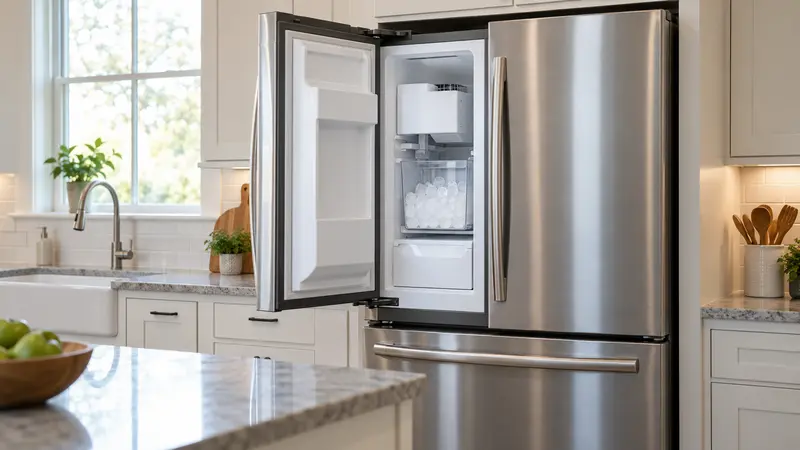
If your Samsung RF28HMEDBSR ice maker is not working, first confirm that Ice Maker Off is not selected, check for frost around the ice room and bucket, verify water flow at the dispenser, and run one Test cycle. On this model, the symptom usually falls into one of three paths: the ice maker is frozen, it cycles but does not fill with water, or it fills but does not harvest the cubes.
This guide applies specifically to the Samsung RF28HMEDBSR and RF28HMEDBSR/AA French-door refrigerator. The last two digits after /AA identify a production revision, so switch locations and replacement parts can vary. Confirm the full model and serial label inside your refrigerator before ordering a part.
Quick diagnosis: what is your RF28HMEDBSR doing?
- Ice bucket is stuck or the ice room is packed with frost: suspect air leakage, an ice-room sealing issue, or a defrost-related fault.
- Test cycle runs but no water enters: check the supply valve, water line, filter, fill tube, and inlet valve.
- Tray fills but cubes never dump: suspect ice-room temperature, the ice maker assembly, temperature sensor, wiring, or control.
- Ice is in the bucket but will not dispense: that is primarily a dispenser or auger problem, not a no-ice-production problem.
- No chime and no movement during Test: power-cycle once; if the unit still does not respond, service is appropriate.
Samsung RF28HMEDBSR ice maker troubleshooting step by step
1. Make sure the ice maker is turned on
Look at the control panel for the Ice Maker Off indicator. On RF28HMEDBSR versions, the Ice Maker Off control also relates to the panel-lock function, so unlock the controls first if the button does not respond. Press the Ice Maker Off button as described in the manual for your exact revision and confirm the off indicator is no longer illuminated.
If someone recently cleaned the panel, changed settings, or restored power, this simple setting is worth checking before any physical troubleshooting.
2. Confirm the freezer is cold enough
Samsung specifies a freezer setting of 0°F (-18°C) for normal ice production. A displayed set point is not proof of the actual temperature, so use an appliance thermometer if food seems softer than normal or the refrigerator has other cooling symptoms.
If the freezer cannot maintain temperature, diagnose the broader cooling problem first. Our refrigerator not cooling guide explains safe airflow, door-seal, and condenser checks.
3. Inspect the ice bucket and ice room for frost
The RF28HMEDBSR uses an ice maker in the refrigerator compartment, inside a separately cooled ice room. Remove the bucket only if it slides out normally: lift it slightly and pull it toward you with both hands. Confirm it is empty of scoops or other objects, then reinstall it fully so it seats and locks.
Heavy frost, a solid block of ice, water tracks, or a bucket that will not release points to more than a routine reset. Do not pry the bucket out and do not apply concentrated heat. Those methods can crack the liner, warp plastic, damage wiring, or create an electrical hazard. Arrange service for a controlled thaw and an inspection of the ice-room seals and updated repair parts.
4. Run one ice maker Test cycle
With the bucket removed, locate the Test button on the right side of the ice maker housing. Press and hold it until you hear a chime; Samsung notes that this can take up to 10 seconds. Release the button and let the full cycle finish. On a refrigerator-compartment ice maker, the test may take about six minutes.
Watch and listen rather than pressing Test again. The tray should move through a harvest cycle, and near the end you should hear the water valve hum and water enter the tray.
- Movement and water fill: reinstall the bucket and allow time for production to resume.
- Movement but no water: continue to the water-flow checks below.
- Water enters but later freezes without dumping: temperature sensing, the ice maker assembly, wiring, or control may be at fault.
- No chime or movement: unplug the refrigerator or switch its breaker off for two minutes, restore power, and try the Test button once more. If it remains unresponsive, stop and schedule service.
Do not run repeated Test cycles. Repeated fills can overflow the tray or create an ice jam.
5. Check water flow and the filter
Confirm that the household shutoff valve is fully open and the refrigerator water line is not pinched behind the cabinet. Then test the door dispenser. Samsung’s practical flow check is at least 6 fluid ounces (3/4 cup) in 10 seconds. Weak dispenser flow makes a restricted filter, low household pressure, or a kinked line more likely.
If the filter is old, incorrectly seated, or the problem began just after replacement, reinstall the correct filter for this model and flush it according to its instructions. A temporary filter-removal test may help identify a restriction, but do not operate indefinitely without the correct filter or approved bypass arrangement. For more detail, see our refrigerator water dispenser troubleshooting guide.
If your home uses a reverse-osmosis system, supply pressure can be too low for reliable ice production. A plumber can test the refrigerator supply line safely.
6. Look for a frozen or restricted fill path
If the dispenser has strong flow but the Test cycle produces no water, the ice maker’s fill tube may be frozen or blocked. You can visually inspect the accessible outlet with the refrigerator unplugged, but do not insert a knife, drill bit, or wire and do not remove energized components.
A frozen fill tube can be a symptom rather than the root cause. Possible sources include a seeping inlet valve, airflow or temperature problems, or recurring ice-room moisture. Repeated freezing deserves professional diagnosis.
7. Allow enough time after a reset
A successful test does not mean the bucket will fill immediately. Reinstall the bucket correctly, keep the doors closed, and allow up to 24 hours for normal production to stabilize. Power Freeze may temporarily speed recovery, but it does not repair a recurring freeze-up or a failed component.
8. Separate ice production from dispensing
If the bucket contains ice but pressing the lever produces nothing, the ice maker has already done its job. Check that the bucket is seated, the chute is clear, and the control lock is off. A frozen bucket, damaged auger, dispenser switch, door switch, or auger motor can prevent delivery. Start with our broader refrigerator ice maker not working guide to compare production and dispensing symptoms.
Most common causes on the RF28HMEDBSR
Ice buildup inside the ice room
Recurring frost is one of the most important model-specific clues. Warm, humid refrigerator air entering the ice compartment can freeze around the bucket, fan, tray, or fill area. A technician may need to inspect sealing, drainage, ice-room components, and any service updates appropriate to the unit’s production revision.
Restricted water filter or low supply pressure
Low flow can prevent the tray from filling or create small, incomplete cubes. The quick dispenser test helps separate a refrigerator-wide water restriction from an ice-maker-only fault.
Frozen fill tube or faulty water inlet valve
The inlet valve must open during the fill portion of the Test cycle and close completely afterward. A valve that does not open can cause no fill; a valve that seeps can contribute to freeze-ups. Valve testing involves electricity and water connections and is a technician-level repair for most homeowners.
Failed ice maker assembly
The assembly contains the tray drive and other operating components. If it receives water and the ice room is cold, but the tray will not harvest—or the Test button remains unresponsive after a power cycle—the assembly may have failed.
Ice-room fan, temperature sensor, heater, or wiring fault
The refrigerator must move cold air to the ice room and monitor temperature correctly. A stalled fan, failed sensor, damaged connector, or defrost/heater problem can stop production or cause repeated icing. These faults may produce error codes and generally require service diagnostics.
Control-board or communication problem
A board fault is possible but should not be the first assumption. Confirm the on/off setting, temperature, water flow, visible frost, and Test-cycle behavior before considering electronic control replacement.
Which parts may cause the problem?
- Ice maker assembly
- Ice bucket or auger assembly
- Water inlet valve
- Water filter or filter housing
- Ice-room fan
- Ice maker temperature sensor
- Fill tube or associated water line
- Ice-room seals, clips, drain components, or model-revision service parts
- Wiring harness or main control board
Do not order from the model name alone. RF28HMEDBSR/AA units have revision numbers, and compatible part numbers can change. Use the complete model code, serial number, and current manufacturer parts lookup or have a servicer confirm compatibility.
When to call a refrigerator technician
Stop DIY troubleshooting and schedule service if the bucket is frozen in place, frost returns after a safe thaw, the Test button produces no response after one power cycle, an error code appears, water leaks inside or behind the refrigerator, the fill tube repeatedly freezes, or electrical covers and wiring must be removed.
Also call a technician when the Test cycle fills the tray but the cubes never harvest. That result narrows the fault but usually requires live-voltage, sensor, fan, heater, or control diagnostics.
Frequently asked questions
How do I reset the Samsung RF28HMEDBSR ice maker?
Remove the ice bucket, press and hold the Test button on the right side of the ice maker until a chime sounds, then allow the cycle to finish without pressing the button again. Reinstall the bucket fully and allow up to 24 hours for normal production.
Where is the Test button on the RF28HMEDBSR ice maker?
It is on the right side of the ice maker housing after the upper ice bucket is removed. The exact appearance can vary by production revision, so check the user manual for your complete RF28HMEDBSR/AA model code if you cannot identify it confidently.
Why is my Samsung RF28HMEDBSR not making ice even though water dispenses?
Strong dispenser flow makes a household supply problem less likely. Check for ice-room frost, run one Test cycle, and note whether the tray moves and fills. A frozen fill tube, ice maker assembly, ice-room fan, sensor, wiring, or control fault may still prevent ice production.
Why does the RF28HMEDBSR ice maker keep freezing up?
Recurring freeze-up can result from humid-air leakage into the ice room, sealing or drainage problems, a seeping inlet valve, or a fan/defrost-related fault. Do not repeatedly attack the ice with heat or sharp tools; have the model revision inspected for the correct repair approach.
How long should I wait after resetting the ice maker?
You may see production begin within a few hours, but allow up to 24 hours for the bucket to start returning to normal. If the Test cycle fails, the ice room freezes again, or no ice appears after the wait, resetting again is unlikely to solve the underlying fault.
Does RF28HMEDBSR/AA mean every refrigerator uses the same parts?
No. The /AA market code can be followed by a revision number, and replacement components may differ by revision. Verify the complete model and serial label before buying an ice maker, valve, fan, sensor, or service kit.
Bottom line
For a Samsung RF28HMEDBSR/AA ice maker not working, the safest sequence is: confirm Ice Maker Off is disabled, verify 0°F freezer operation, inspect for frost without forcing the bucket, run one Test cycle, and check dispenser flow. The cycle’s behavior—no movement, movement without fill, or fill without harvest—provides the clearest clue about whether the problem is water supply, freeze-up, or a failed component.