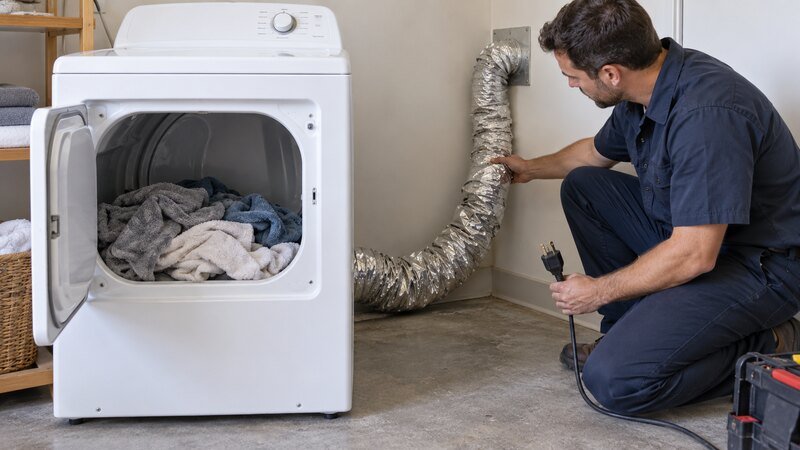
When a GE dryer is not drying clothes, first decide whether the load is cold, warm but damp, or ending early. Cold laundry points toward a heat or supply problem; warm damp laundry usually points toward airflow, load size, washer spin performance, or moisture-sensor contact.
This guide focuses on GE equipment and the stated symptom. Model designs vary, so compare every step with the owner manual for the full model number before removing a cover or ordering a part.
What the Symptoms Tell You
- A normal-size load needs a second cycle even though the drum feels warm.
- The estimated time changes sharply or a sensor cycle ends while seams and waistbands are still damp.
- The exterior vent has weak airflow or the laundry room becomes unusually hot and humid.
- GE electric dryers can run with one supply leg missing, creating a cold or weak-drying complaint even though the drum turns.
Safe Step-by-Step Diagnosis
1. Separate no-heat from slow drying
Run a small mixed load on a heated timed cycle. Check the air only from outside the closed machine; never reach into a running dryer.
2. Check the washer spin result
Laundry should be damp, not dripping. A weak washer spin can double drying time even when the dryer is healthy.
3. Clean the lint screen correctly
Remove lint and clean any invisible softener film from the mesh. Make sure the screen is dry and seated before operation.
4. Inspect the full vent path
Look for a crushed connector and verify strong flow at the outside hood. Long or lint-loaded duct runs need professional cleaning.
5. Match the load to the cycle
Use a medium load of similar fabrics. On sensor models, single garments and mixed heavy/light fabrics can produce uneven results.
6. Use the brand diagnostic only if documented
GE diagnostic procedures differ widely between timer and electronic models. Record lights or codes and use the exact model literature.
Most Likely Causes
Blocked vent or lint screen
Poor airflow is the most common reason a dryer produces heat but leaves clothes damp. It also raises temperatures and fire risk.
Overloaded or badly mixed load
Bulky items can wrap around smaller pieces, while one heavy towel among light garments can fool automatic sensing.
Weak washer extraction
A clogged washer drain, unbalanced spin, or low spin-speed selection leaves too much water for one dryer cycle.
Moisture-sensor contact or residue
Sensor bars or thermistor feedback can end the cycle early, while older timer models use a different control path.
Partial heat loss
Reset both linked breaker handles once on electric models. A timer contact, heater circuit, gas ignition system, or thermostat may also reduce heat.
Exhaust installation problem
Foil-style crushed ducting, excessive elbows, or a stuck exterior damper can reduce airflow even when the lint screen looks clean.
Temperature-control fault
A thermistor, thermostat, relay, or wiring fault can cycle heat incorrectly. Internal testing requires power disconnected and model-specific specifications.
Reset or Restart Procedure
Disconnect power briefly for electronic controls. If both breaker legs will not remain on, leave the dryer off and call a professional.
Components Related to This Problem
Parts sometimes involved include moisture-sensor bars, thermistor, thermostats, thermal fuse, heater or gas ignition components, blower wheel, drive system, wiring, and the control board. Diagnose the airflow and load first because replacing parts will not correct a blocked exhaust.
When to Call a Professional
Stop troubleshooting and arrange qualified service if you smell gas, see scorched wiring, repeatedly trip a breaker, find water near electrical parts, or need to remove sealed panels. Internal electrical tests must be performed with power disconnected and by someone trained to follow the model-specific service information.
Also call for service when the same code or symptom returns after one safe reset and the external checks pass. Give the technician the model number, complete error code, cycle used, and when the problem occurs.
Related Troubleshooting Guides
- Dryer Taking Too Long to Dry? 8 Causes to Check
- Dryer Not Heating? 7 Common Causes and Safe Checks
- GE Dryer Not Heating
Frequently Asked Questions
Why does my GE dryer take two cycles?
The most common reasons are restricted airflow, an oversized or mixed load, or clothes entering the dryer too wet. Heat loss and sensor faults are also possible.
Why are clothes warm but still damp?
The dryer is making heat, but moisture is not leaving efficiently or the cycle is ending before thicker areas are dry. Check the vent and load composition.
Should I use Timed Dry instead of Sensor Dry?
Timed Dry is useful for diagnosis. If Timed Dry works but automatic cycles end early, clean the sensor area and adjust load size before assuming a control failure.
Can I run the dryer with the vent disconnected?
Do not use a disconnected dryer as a normal operating condition. It releases lint, moisture, and—on gas models—combustion products into the room.
When is slow drying dangerous?
Stop if the cabinet, cord, plug, laundry room, or load becomes unusually hot, if you smell burning or gas, or if the breaker trips.
Bottom Line
Begin with settings, loading, accessible filters or vents, hoses, doors, and external supplies. Stop before live-voltage, gas, sealed refrigeration, or internal motor and control work. A careful symptom record is more useful than replacing a part based on the code or headline alone.