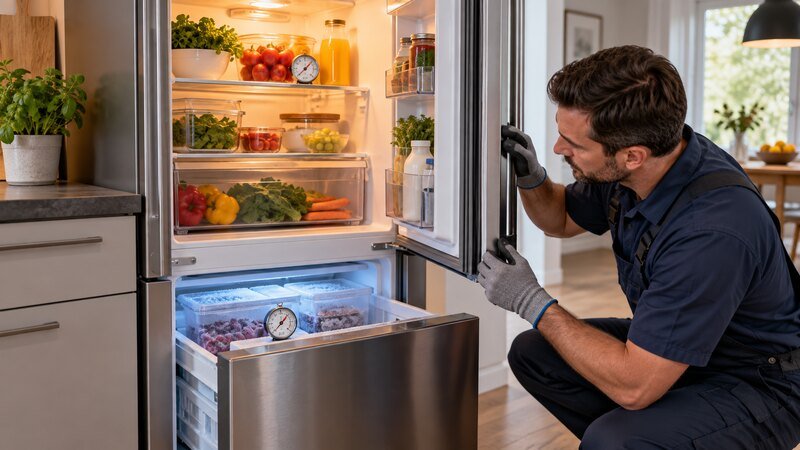
When a GE refrigerator ice maker is not working, check the feeler arm or power switch, freezer temperature, household water valve, filter flow, and visible fill tube before scheduling service.
Safety first: Unplug the refrigerator before removing panels or touching wiring. Do not use sharp tools or concentrated heat to remove ice, and do not work on the sealed refrigerant system.
What Does Ge Refrigerator Ice Maker Not Working Mean?
GE refrigerators use several ice-maker designs. The same no-ice symptom can come from an off position, a warm freezer, no water reaching the mold, cubes holding the feeler arm up, or an electrical failure.
Error labels and service procedures can vary by model and production year. Use the model number from the appliance label when checking the owner’s manual or ordering parts. Do not assume that a code on one model has exactly the same test procedure on another.
Symptoms That Help Narrow Down the Problem
- The mold is empty and dry.
- The feeler arm stays raised.
- The green light flashes on some electronic models.
- Cubes are unusually small.
- Water dispenses normally but the maker never harvests.
Write down when the symptom appears, whether it follows a power interruption, and whether temperatures, airflow, sound, or cycle behavior changed. Those details help separate a temporary control event from a recurring component fault.
Most Likely Causes
1. Feeler Arm or Switch Is Off
A wire arm in the STOP position or a slide/paddle switch set to off prevents new cycles.
2. Cubes Obstruct the Shutoff Mechanism
Fused cubes can hold the arm up and make the maker think the bin is full.
3. Freezer Compartment Is Too Warm
GE manuals commonly list a warm freezer as a reason an automatic ice maker will not operate.
4. Water Supply Is Closed or Restricted
A closed valve, clogged saddle valve, kinked line, or low pressure can leave the mold dry.
5. Filter or Fill Tube Is Blocking Flow
A restricted filter or frozen fill tube can affect the maker even when some dispenser flow remains.
6. Ice Maker or Valve Has Failed
The mold heater, thermostat, motor, water valve, harness, or control may require qualified testing.
Safe Step-by-Step Troubleshooting
Step 1: Check the on/off design
Identify the feeler arm, power switch, or electronic control shown in the GE manual and place it in the operating position.
Step 2: Free the arm safely
Remove loose cubes that touch the arm or mold. Do not bend the arm or use heat to force ice loose.
Step 3: Verify freezer temperature
Make sure food does not block vents and doors seal. Give a newly installed unit enough time to reach normal temperature.
Step 4: Inspect household water supply
Confirm the shutoff valve is fully open and the line is not pinched behind the refrigerator.
Step 5: Compare dispenser flow
Weak water flow supports a supply or filter problem; normal flow does not rule out a separate ice-maker valve circuit.
Step 6: Follow the exact GE test procedure
Status lights and test cycles differ among mechanical and electronic GE ice makers. Use the model documentation.
How to Reset It Safely
A brief power cycle can restart some controls, but GE does not use one universal refrigerator ice-maker reset. Do not move gears, energize test points, or force a harvest manually.
After power is restored, allow the appliance time to restart and monitor it. Do not keep cycling the breaker if the code immediately returns or the breaker trips.
Parts and Components That May Be Involved
Service diagnosis can involve the ice maker, feeler-arm mechanism, water inlet valve, filter head, fill tube, mold thermostat, heater, door switch, harness, or main board. Match parts to the full model number.
Part numbers and diagnostic values are model-specific. Confirm the full model and serial number before any replacement, and avoid replacing parts based only on the display code.
When to Call a Professional
The maker leaks or overfills.,The green status light continues an abnormal flash pattern.,The freezer is not maintaining temperature.,The water valve or internal wiring needs testing.,The maker remains dry after verified supply and safe checks.
A qualified appliance technician can use model-specific service information and controlled tests to identify the failed circuit without exposing you to moving parts, sharp edges, gas, refrigerant, or hazardous voltage.
Frequently Asked Questions
Why is my GE refrigerator not making ice?
The most common safe checks are the maker switch or arm, freezer temperature, water valve, line, filter, and cubes obstructing the shutoff mechanism.
Does a GE ice maker have a reset button?
Some electronic designs have a test or status procedure, while others do not. Use the instructions for the exact model rather than a generic button sequence.
Why does the water dispenser work but not the ice maker?
The maker uses its own fill request, valve path, thermostat, and harvest mechanism, so normal dispenser flow does not prove every ice-making component works.
Can I thaw the fill tube with a heat gun?
No. High heat can damage plastic, insulation, wiring, and the liner. Use only GE-approved instructions or service.
How long after installation should GE make ice?
Allow the refrigerator to cool and complete multiple fill-freeze-harvest cycles. The manual gives the best timing for the specific model.
Related Troubleshooting Guides
refrigerator ice maker not working guide, GE refrigerator cooling checks, refrigerator not cooling guide.
Manufacturer reference: GE refrigerator ice-maker support.