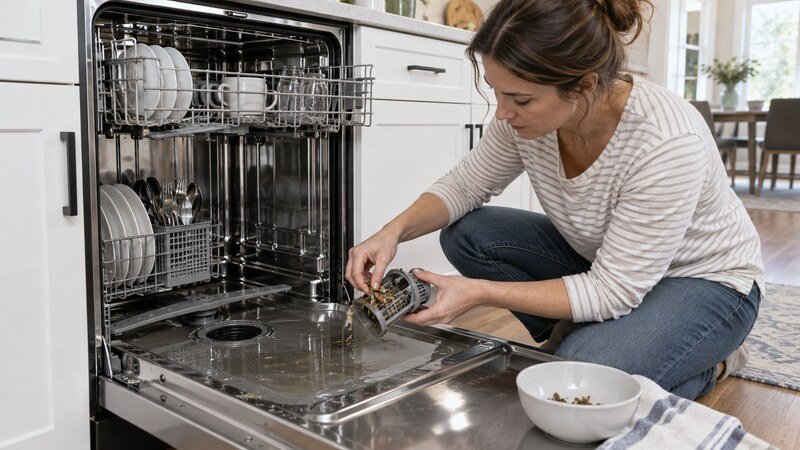
A Maytag dishwasher that leaves water may have an interrupted cycle, a restriction in the filter or hose, a blocked sink connection, or a drain-pump problem. Because filter designs vary, remove only parts shown in the owner’s manual.
Safety first: Stop the appliance and disconnect power before touching accessible filters, hoses, or panels. Never bypass a door or lid switch, probe energized wiring, or continue using an appliance that smells hot, sparks, leaks near electrical parts, or repeatedly trips a breaker.
What to Check First
Before replacing a part, note when the symptom occurs, any display code, whether the appliance completes a controlled test, and the full model number. Those details prevent unrelated parts from being replaced.
Step-by-Step Diagnosis
1. Use Cancel/Drain
Close the door and hold or press the documented cancel control.
2. Check the sink and disposal
Run the disposal and make sure the sink is not backing up.
3. Remove pooled water safely
Disconnect power before reaching into the tub.
4. Clean accessible filters
Rinse food soil and reinstall parts in their locked position.
5. Inspect the sump surface
Remove visible debris with gloves; do not force internal covers.
6. Correct the hose
Remove kinks and keep the required high loop.
7. Clear the air gap
Clean it if installed on the countertop.
8. Check disposal installation
Make sure the inlet knockout was removed.
9. Call for service when needed
Recurring F9E1-type behavior, humming, silence during drain, leaks, or a damaged pump path requires diagnosis.
Components Related to This Symptom
A technician may inspect the filter system, drain hose, air gap, disposal inlet, drain pump, check valve, wiring, latch circuit, and control. The symptom alone does not prove that any one component has failed.
When to Call a Professional
Schedule service when the safe external checks do not solve the problem, the same code returns, or diagnosis requires a meter, internal wiring access, appliance removal, gas work, or major disassembly. Stop immediately for smoke, burning or gas odor, sparking, a hot plug, a repeated breaker trip, water near electrical parts, or severe mechanical noise.
Related Troubleshooting Guides
dishwasher not draining, Whirlpool dishwasher F9 E1 error, water in dishwasher when not in use.
Frequently Asked Questions
Is water in the sump always a fault?
A small amount below the filter can be normal; water covering the tub floor is not.
Can the sink cause dishwasher drainage problems?
Yes. A blocked disposal, air gap, or sink branch can prevent discharge.
Can I pour cleaner into the standing water?
No. Chemical drain cleaner is unsafe for the dishwasher and for later service.
Bottom Line
Start with the checks that require no disassembly, use only the documented procedure for the exact model, and stop guessing if the symptom returns. A qualified technician can test the safety, drive, drainage, sensing, wiring, and control components under the correct conditions.