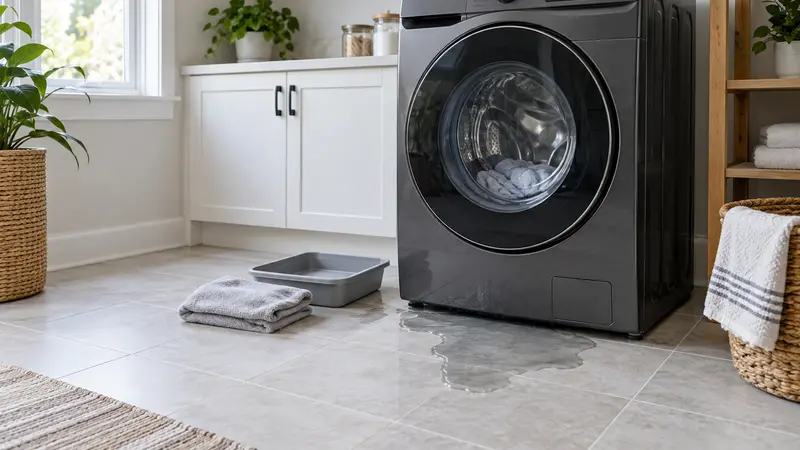
If your Samsung washing machine is leaking, stop the cycle, unplug the washer, close both water-supply valves, and dry the floor before inspecting it. The fastest diagnosis is to find the first wet point—not simply the largest part of the puddle. Water can travel along the cabinet and make a rear hose, door seal, drain connection, or nearby standpipe look like a bottom leak.
Samsung sells front-load and top-load washers with different layouts, so confirm the model number before ordering a part. The safe checks below apply broadly, while the owner’s manual shows the exact filter, hose, and dispenser locations for your machine.
First, identify where the leak starts
Behind the washer
Use a flashlight without moving a running washer. Clear water near the wall usually points to a supply-hose connection, faucet, inlet-hose washer, drain hose, or an overflowing standpipe. Check the full hose length only after power and water are off.
At the front
On front-load models, inspect the door glass and every fold of the rubber boot for hair, a trapped garment, detergent film, cuts, or distortion. Water at a top-load cabinet front may have splashed over the tub ring or traveled from a dispenser.
Under the cabinet
A puddle underneath can begin at an external hose, drain-pump filter, internal tub-to-pump hose, drain pump, inlet valve, or tub seal. Do not tilt the washer or remove panels to find it; note when the water appears and give that evidence to a technician.
Most likely causes
- Loose or damaged supply hoses: leaks may continue while the washer is off if a valve remains open.
- Drain hose or household drain trouble: water appears mainly during draining or spin.
- Too much or non-HE detergent: excess foam can escape through vents and seams.
- Door boot contamination or damage: specific to front-loaders.
- Dispenser blockage or incorrect insert: water backs up during fill.
- Internal pump, hose, valve, or tub-seal failure: service is normally required.
Safe step-by-step leak check
- Stop the cycle and isolate power and water.
- Dry the machine, hoses, valves, standpipe area, and floor completely.
- Inspect both inlet hoses and their threaded connections for moisture, cracks, bulges, or corrosion.
- Confirm the drain hose is secured but not airtight in the standpipe, and look for signs the household drain overflowed.
- Check the detergent label and use only the recommended amount of HE detergent.
- For a front-loader, clean the door glass and gasket with a damp cloth; do not use sharp tools.
- If no defect is visible, run only a brief monitored rinse after the floor is dry. Stop immediately at the first drip and record whether it began during fill, tumble, drain, or spin.
For location-specific help, see our guides to a Samsung washer leaking from the bottom, a Samsung washer leaking at the door, and a Samsung washer detergent-drawer leak.
Parts that may be involved
Depending on the model and leak timing, a technician may inspect the inlet valve, dispenser-to-tub hose, door boot, drain-pump filter seal, drain-pump housing, tub-to-pump hose, pressure-system hose, outer tub, or tub seal. Match every part to the complete model code.
When to Call a Professional
Request service if water reaches an outlet, cord, motor area, or internal wiring; the washer trips a breaker; a hose is inaccessible; the door boot is torn; the leak comes from inside the cabinet; or a large leak returns after basic checks. Do not operate a leaking washer unattended.
FAQ
Can too much detergent make a Samsung washer leak?
Yes. Excess or non-HE detergent can create foam that escapes through the dispenser, door, or vent and then runs underneath.
Why does it leak only when draining?
That timing favors the drain hose, standpipe, pump-filter seal, tub-to-pump hose, or drain pump rather than the supply side.
Should I reset the washer?
A power reset does not repair a physical leak. Find and correct the water source first.
Samsung’s current washer leak troubleshooting guide also emphasizes identifying the source and requesting service when basic checks do not resolve it.