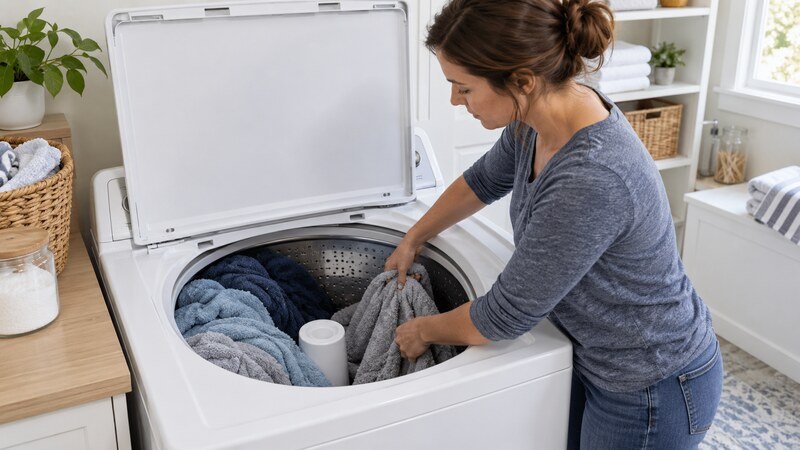
A GE washer not spinning is often responding to standing water, an unbalanced load, a lid or door lock problem, or a selected low-spin setting. Before assuming a failed motor, check what the washer does immediately before spin: a GE washer that drains, hums, or stops with wet clothes points to a different set of causes. GE top-load and front-load washers use different lock and drive systems, so identify the washer style and model before moving beyond external checks.
Safety first: Stop the appliance and disconnect power before removing a filter cover, access panel, hose, or internal part. Never test energized components, bypass a lid switch or door lock, or attempt major disassembly if you are not trained.
What to Check First
- Check whether water is still in the tub. A GE washing machine generally will not enter full spin while it still detects water.
- Redistribute the load, especially towels, bedding, or one heavy item. Remove some items if the basket is tightly packed; add a few similar items if one item is too small to balance.
- Confirm that a low-spin or no-spin option was not selected, then run Drain & Spin with an empty or small balanced load.
- Close the lid or door firmly and look for a lock message, flashing light, or repeated clicking.
- Make sure the washer does not rock. All four feet should contact a solid floor.
Common Causes of a GE Washer Not Spinning
A GE washing machine not spinning can have a simple load, cycle, drain, or lock cause before it points to an internal drive or control fault.
1. The load is unbalanced, too large, or too small
GE washers may reduce or cancel high-speed spin when the control detects an out-of-balance load. Pause the machine and spread towels or bedding evenly around a top-load basket. In a front loader, separate tangled pieces and remove some items. Excessively small loads can also be difficult to balance when they contain one heavy article.
2. The wrong spin option or excessive suds
Some fabric cycles intentionally use lower spin speeds. Confirm the selected program and spin option before assuming the GE washer spin cycle is not working. Excessive suds can also delay draining and balancing, so use the correct detergent type and amount for the machine.
3. A drain restriction is blocking spin
Inspect the drain hose for kinks and confirm the household standpipe is not backing up. Front-load models may have a serviceable pump filter; use only the instructions for your exact model and prepare for water release. If water stays in the tub or drains slowly, start with our GE washer not draining checks.
4. The lid or door will not lock
Top loaders rely on a lid switch or lock, while front loaders use a door-lock assembly. Clean detergent residue around the strike and close the lid or door firmly. If the lock clicks repeatedly, displays a lock message, or will not hold, do not bypass it.
5. A drive, sensor, or control problem
A motor sound without basket movement, a burning smell, grinding, or a basket that is difficult to turn by hand can point to a belt, pulley, clutch, mode shifter, motor, pressure sensor, or control fault. These parts differ across GE designs and need model-specific diagnosis after safe external checks are complete.
GE Washer Drains but Won’t Spin
When a GE washer drains but won’t spin, the drain path is less likely to be the only problem. First test with a small balanced load, confirm the spin option, and check that the lid or door locks. If the GE washing machine will not spin after those checks, the lock system, belt or pulley, mode shifter, clutch, motor, sensor, or control may require professional testing. A General Electric washer not spinning after it has fully drained should not be forced into spin or repeatedly restarted if it makes a burning or grinding sound.
GE Top Load Washer Not Spinning
A GE top load washer not spinning may be trying to correct an unbalanced basket before it accelerates. Check the load first, then observe whether the lid lock engages. Depending on the model, a top loader may use a belt, mode shifter, clutch, pulley, capacitor, or motor system to change from agitation to spin. Do not reach beneath the washer, tilt it alone, or remove protective panels unless trained.
GE Front Load Washer Not Spinning
A GE front load washer not spinning can be held out of high-speed spin by a door-lock issue, drainage restriction, excessive suds, or an out-of-balance load. Check the door seal and strike for trapped laundry, then use the exact model manual before accessing a drain filter. If the washer displays a code, record it rather than relying on a generic reset or replacing a part by guesswork.
GE Washer Spin Cycle Not Working
A GE washer spin cycle not working may actually be a normal sensing pause, a reduced-speed cycle, or a load-balance response. Allow several minutes for the washer to sense and rebalance before calling it a failure. If a GE washing machine spin cycle is not working with several ordinary, balanced loads and Drain & Spin also fails, service is appropriate.
GE Washer Humming but Not Spinning
A GE washer humming but not spinning does not automatically mean the motor has failed. The sound may come from a pump trying to drain, a jammed drive component, or another part that needs model-specific diagnosis. Stop the washer if the hum is accompanied by a burning smell, grinding, smoke, a hot plug, or a repeated breaker trip; do not continue cycling it.
GE Washer Not Spinning Clothes Dry
If a GE washer is not spinning clothes dry, it may be spinning at a reduced speed rather than not spinning at all. Check the load size, spin selection, excess suds, and drainage before assuming a drive problem. Wet clothes after one unusual bulky load often point to balance; wet clothes after repeated normal loads need closer diagnosis.
Safe Reset and Basic Tests
- Disconnect power for about one minute, then reconnect it if your model manual permits a power reset.
- Select Drain & Spin and use an empty or small balanced load.
- Watch whether water leaves the tub before the basket accelerates.
- Stop the test for severe banging, leaks, a hot or burning smell, sparks, or a tripped breaker.
Some older Hydrowave top-load models have a specific motor-reset routine. Use it only when GE documents it for the exact model; do not apply a model-specific procedure to a different GE washer.
When to Call a Technician
Schedule professional service when safe external checks do not solve the issue, the same fault or lock indication returns, or diagnosis requires a meter, internal wiring access, appliance removal, or major disassembly. Stop immediately for smoke, sparking, a burning odor, a hot plug, water near electrical parts, severe mechanical noise, or a repeated breaker trip. Give the technician the complete model number, the exact code or light pattern, when the failure occurs, and whether Drain & Spin changed the symptom.
Related Troubleshooting Guides
These published guides may help you compare the symptom: GE washer not agitating guide, GE washer not draining checks, and our general washer not spinning guide.
Frequently Asked Questions
Why is my GE washer not spinning?
Start with standing water, the load, the selected spin option, and the lid or door lock. If those are normal, a drive, sensor, or control issue may require service.
Why does my GE washer drain but not spin?
Once draining is confirmed, check load balance, spin selection, and lock operation. Repeated failure with a small balanced load can point to a drive, motor, sensor, or control issue.
Why is my General Electric washing machine not spinning?
The cause may be a balance response, a drain or lock issue, excessive suds, or a drive-related fault. The symptom immediately before spin helps narrow the diagnosis.
How do I reset a GE washer that will not spin?
Disconnect power for about one minute and retry Drain & Spin if your model manual permits it. Use a special motor-reset sequence only when GE documents it for that exact model.
Does a GE Profile washer not spinning need a different repair?
GE Profile models can use different features and diagnostics, but the safe first checks are still the load, cycle option, draining, and door or lid locking. Use the model-specific manual for any code or reset procedure.
Can I bypass the GE lid switch?
No. It is a safety device that prevents access to a moving basket and must not be bypassed.
Why is my GE washer humming but not spinning?
A hum can come from a pump or a drive-related problem and does not identify one failed part by itself. Stop the washer for burning smells, grinding, smoke, or electrical symptoms and arrange diagnosis.
Bottom Line
Start with the checks that do not require disassembly: note the cycle behavior, correct the load or installation issue, inspect the accessible drainage path, and perform only the documented reset for the exact model. If the problem returns, stop guessing and have the relevant lock, drive, sensor, wiring, and control components tested professionally.